Debt Consolidation Australia Caravan Loan Repayment Calculator
Plan your next adventure with our Caravan Loan Repayment Calculator. Estimate repayments, view amortization charts, and compare finance options with ease.
Calculator results are estimates only and not quotes. Actual quotes will be provided by licensed brokers after you submit an enquiry.
Caravan Loan Details:
Important!
Caravan Loan Interest Rates differ from lender to lender and will depend on your individual circumstances (credit history, employment status, age, etc.). To find out if you qualify ... and for a free, personalised interest rate and repayment quote,
please CLICK HERE
Caravan Loan Amortisation Calculator
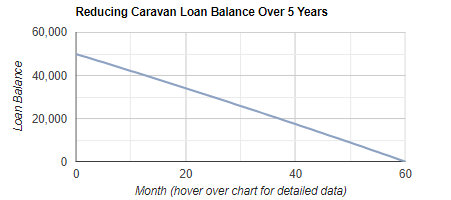
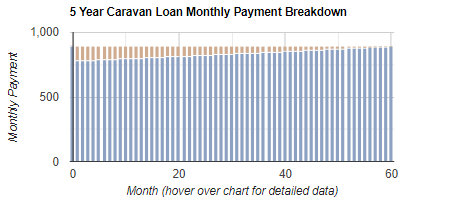
The following amortisation graphs detail month-by-month data on the progress of the proposed loan. The first chart below examines the reducing loan balance over the course of the finance contract term. The second graph illustrates the portion of each monthly repayment allocated to payment of interest vs principal reduction.
How to use our Caravan Loan Repayment Calculator
Our Caravan Loan Repayment Calculator helps you estimate your likely monthly caravan loan repayments, understand how much interest you may pay over time, and visualise your loan via amortisation charts. It’s important because small changes to your purchase price, deposit, loan term or interest rate can materially affect cash flow and the total cost of caravan finance, helping you plan a realistic budget before you apply.
How to complete the form for the best result
1. Purchase Price
Enter the full caravan purchase price you expect to finance. If you plan to roll costs into the loan, consider adding likely upfront expenses such as registration, insurance and other on-road costs (where applicable). Use whole numbers only (no decimals or commas) to match the calculator format.
2. Deposit or Trade-in Value (if applicable)
Add any cash deposit and/or the trade-in value of an existing caravan. If you have no deposit or trade-in, leave this field blank. A higher deposit generally reduces the amount borrowed and can lower repayments and total interest.
3. Term of Loan (years)
Select the number of years you want to repay over. Longer terms usually reduce monthly repayments but increase the overall cost of the loan due to more interest over time. Choose a term that fits your budget with a buffer for rate rises and living costs.
4. Interest Rate (percent per annum)
Select an interest rate to simulate. The listed range is indicative only and your actual rate can only be confirmed after you apply, based on factors like credit history and employment.
5. Calculate
Click calculate to generate your estimated repayment and amortisation charts.
How to interpret the results
1. Repayment estimate
Use the monthly repayment figure as a budgeting guide, then compare scenarios by adjusting the term, deposit and interest rate.
2. Amortisation charts
The loan balance chart shows how your debt reduces month by month. The interest versus principal chart highlights that early repayments typically include a higher interest portion, with more of each payment going to principal later in the term.
Important information (ASIC-style general guidance)
Results are estimates and do not constitute a quote. They may not include fees, charges, or lender-specific features. This information is general and does not consider your objectives, financial situation or needs. Consider whether a caravan loan is appropriate for you and seek personalised advice if required. Credit is subject to approval and terms and conditions.
Welcome to our comprehensive guide where we aim to debunk common myths surrounding debt consolidation and debt reduction. This blog post serves as a beacon of clarity for those who find themselves navigating through the choppy waters of financial jargon and conflicting information. - read more
Welcome to our guide on how to avoid falling back into debt after consolidating your debts. Debt consolidation can be a fantastic way to manage multiple financial obligations, combining them into a single, more manageable payment plan. But the journey doesn’t end there. - read more
Financial stability is a common aspiration, yet many Australians find themselves weighed down by the burden of debt. Whether it’s due to loans, credit cards, or unexpected financial emergencies, the struggle to stay afloat is a reality for countless individuals striving to achieve their dreams of a secure, debt-free future. - read more
Welcome to our blog, where we're dedicated to helping you make the most of your financial journey. Today, we're going to delve into an important aspect of financial health: tracking your progress after debt consolidation. - read more
Bad credit does not automatically rule out a debt consolidation loan in Australia, but it can affect eligibility, interest rates, loan amount, security requirements and lender choice. This guide explains what lenders may assess and what to consider before applying. - read more
The latest Australian lending indicators are a reminder that personal loans remain an important part of household finance, particularly for people trying to smooth out cash flow, cover large costs or bring several debts under one repayment. For Australians already juggling credit cards, car finance, buy now pay later balances or other unsecured debts, the trend is worth watching closely. - read more
The latest Australian credit card lending updates have put household debt back under the spotlight, with many borrowers still carrying balances that attract high interest. While spending patterns can shift from month to month, the broader message is clear: when everyday costs remain elevated, credit cards can quickly move from convenience to financial pressure. - read more
A recent Finder credit card example has put a sharp spotlight on a problem many Australians quietly face: the minimum repayment can look manageable, while the true cost of carrying card debt may be enormous. In the example, a low five-figure credit card balance would take an estimated 73 years to clear if only the minimum repayment was made, with interest costs nearing $64,000 over time. - read more
A fresh round of lender competition is giving some Australian borrowers a reason to review their debts, but the benefits are not being shared evenly. Canstar reported on 16 July 2026 that 23 lenders have cut at least one variable home loan rate since 1 May, despite the Reserve Bank's rate hikes in February, March and May. The catch is that these reductions are aimed at new borrowers, or existing customers willing to refinance and effectively become new customers elsewhere. - read more
Australian credit card debt is again moving in the wrong direction, with Canstar’s latest analysis of Reserve Bank of Australia figures showing personal credit card debt accruing interest reached $19.4 billion in May 2026. The increase was $61 million for the month, and while that may look modest beside the national total, it signals a deeper issue for households already stretched by rent, mortgage repayments, groceries, utilities and other everyday costs. - read more